
Buses in Stockholm — A Complete Guide to Routes, Stops, Night Buses and Travel Across the County
Buses are one of the most important parts of public transport in Stockholm County. Around 500 bus routes connect central Stockholm with suburbs, municipalities, residential areas and smaller towns. Some buses run at frequent intervals through the city, while others take passengers to commuter trains, the metro, archipelago piers and places far beyond the centre. This guide introduces the bus network, route numbers, major interchange points, tickets and how to plan a journey.
Published 10 October 2026 · Updated 30 October 2026 · 15 min read
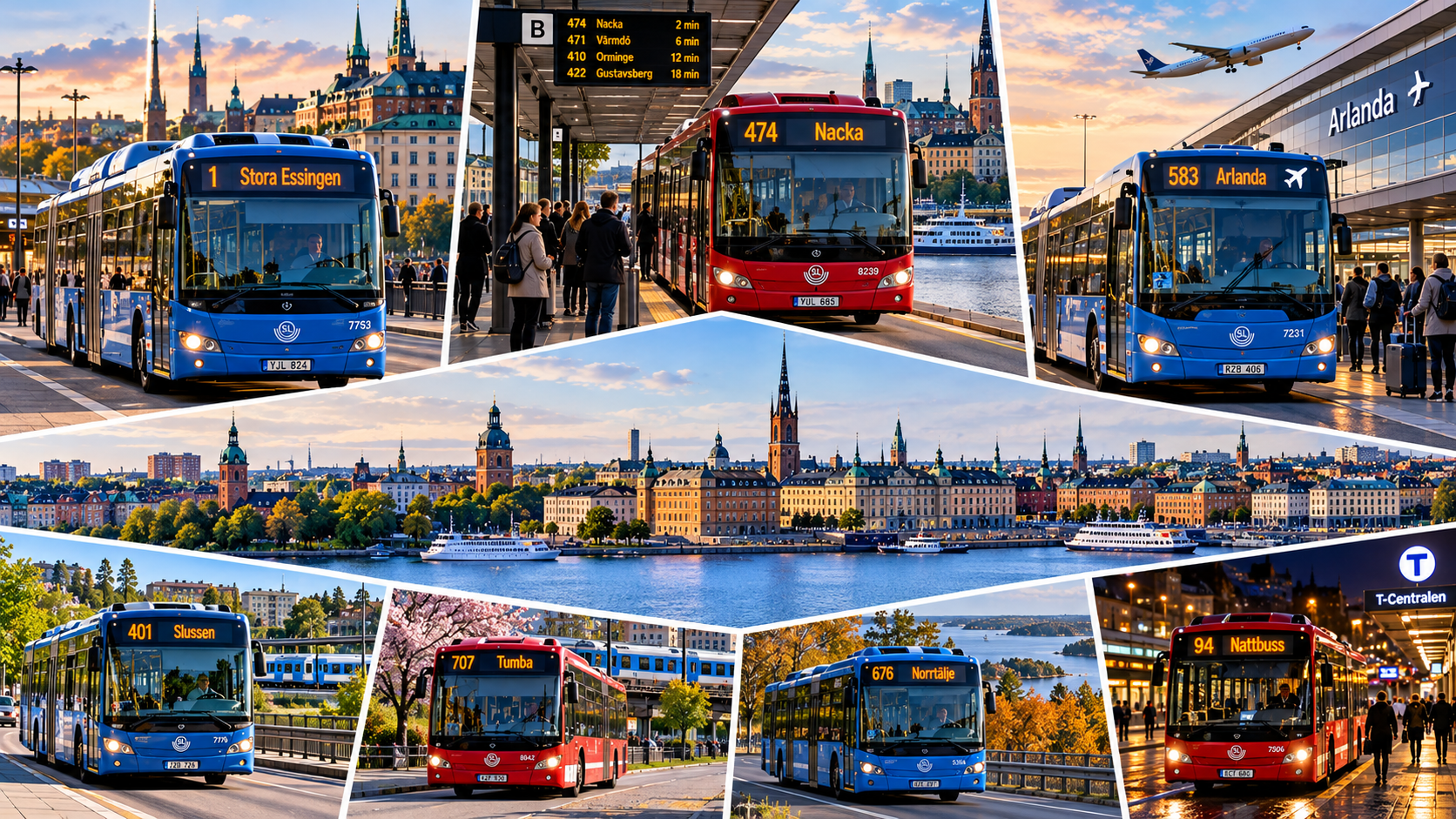
Stockholm's Bus Network — From the City Centre to the Outermost Parts of the County
Public transport in Stockholm includes the metro, commuter trains, trams, light rail, commuter boats and buses. Buses have a particularly important role: they reach places without rail services and connect residential areas with major interchange points.
According to SL, Stockholm County has around 500 bus routes and approximately 6,500 bus stops. The network includes both dense urban services and routes in more sparsely populated areas.
In the inner city, buses may run every few minutes during rush hour. In the outer parts of the county, some routes have considerably fewer departures. It is therefore important to check the timetable for the specific journey.
There is no single bus route covering all of Stockholm. Instead, the network consists of many routes that complement one another and connect with the metro, commuter trains, light rail and boats.
1. Blue Buses and Trunk Routes — Services Along Major Travel Corridors
In Stockholm, the term "trunk route" is used for bus routes that play an important role in the public transport network. Many of these are blue buses, but the colour alone does not tell you everything about how a route operates.
Trunk buses are often designed to connect large residential areas, workplaces and important interchange points. They may offer a more direct journey than several local buses with transfers.
SL describes, among others, routes with numbers ending in 70 as trunk routes. Examples include 74, 172, 474 and 676. This is not, however, a rule that identifies every type of trunk service.
Examples of important trunk routes
Route 74 serves parts of the inner city and nearby areas. Check its current route and final stop in the journey planner.
Route 172 is an example of a trunk route in southern Stockholm.
Route 474 connects parts of Nacka and Värmdö with important interchange points.
Route 676 is an important connection in the north-eastern part of the county, including between Stockholm and the Norrtälje area.
The routes above are examples, not a complete list. Service patterns, stops and departures may change.
2. Inner-City Buses — Travelling Around Stockholm
Buses in central Stockholm complement the metro and provide connections to streets and districts that are not always close to a metro station.
Services run through areas including Norrmalm, Östermalm, Vasastan, Kungsholmen and Södermalm.
Inner-city buses are used by commuters travelling to work or studies, visitors heading to hotels, museums and attractions, passengers changing to another metro line, and people making shorter journeys without walking all the way to a metro station.
According to SL, routes numbered between 1 and 96 mainly operate in the inner city and nearby areas. There are exceptions, and the route number should always be checked together with the current destination.
Bus or metro? For a journey between two central metro stations, the metro may often be faster. For an address some distance from a station, the bus may be more convenient. A bus can also be a good option if you want to avoid a transfer or your destination is on a direct route. Compare journey time, walking distance and the number of transfers.
3. Buses in Northern and North-Western Stockholm
In the northern and north-western parts of the county, buses connect residential areas, town centres and workplaces with metro and commuter train stations.
Services operate in areas including Solna and Sundbyberg, Västerort, Sollentuna, Upplands Väsby, Märsta and Sigtuna, Järfälla, and Upplands-Bro.
Routes in the 500 series mainly operate in this part of the county, according to SL.
Important interchange points
Solna centrum and Sundbyberg: connections to several forms of rail transport and local buses.
Barkarby: an important interchange for buses, commuter trains and other public transport.
Sollentuna: buses connect with commuter trains and other local routes.
Märsta: an important station for onward travel towards Sigtuna, the Arlanda area and the northern part of the county.
Always check which stop is best for your destination. Two stops with similar names may be on different sides of a large area.
4. Buses in North-Eastern Stockholm
The north-eastern sector has an extensive bus network connecting Danderyd, Täby, Vallentuna, Vaxholm, Österåker and Norrtälje with Stockholm and other interchange points.
Routes in the 600 series mainly operate in this part of the county.
Buses are important because the distances between residential areas and rail services can be substantial. Some routes run frequently during rush hour, while others have less frequent service.
Täby, Vallentuna and Österåker: buses are used for local journeys and connections to the Roslagsbanan railway. A bus may, for example, be the first part of a journey continuing towards Stockholm.
Vaxholm and Norrtälje: buses connect residential areas and smaller towns with central hubs. Some journeys can be relatively long, so it is especially important to check departure times and transfers. If travelling late in the evening, check the last departure in advance.
5. Buses in Eastern Stockholm — Nacka and Värmdö
Nacka and Värmdö have many bus routes connecting residential areas with Slussen, other interchange points and local centres.
Routes in the 400 series mainly operate in Nacka and Värmdö.
Buses towards Slussen: Slussen is a central interchange for journeys between eastern Stockholm, the inner city and other parts of the county. Buses have traditionally played an important role for commuters from Nacka and Värmdö.
Traffic arrangements and stop locations in the Slussen area have changed during redevelopment. Always check the current stop in the journey planner.
Journeys to Värmdö: buses are used for commuting and leisure trips. Demand may change in summer, when more people travel to areas close to the archipelago. Some journeys may require a transfer to a boat or another bus. Check connections carefully if travelling to a pier or an area outside the larger built-up areas.
6. Buses in Western Stockholm and the Mälaren Islands
In the western part of the county, buses are important for journeys between Ekerö Municipality, the Mälaren islands and the rest of Stockholm.
Routes in the 300 series mainly serve Ekerö Municipality and the Mälaren islands.
Buses connect local residential areas with major interchange points for the metro and other public transport.
Journeys from Ekerö: for many passengers, the bus is the first part of a longer journey towards central Stockholm. Travel time is affected by road traffic. During rush hour, allow extra time, especially if you need to catch a train or arrive at an appointment.
Check alternative routes: if a bus is delayed, the journey planner may show alternatives. Not every alternative is necessarily faster, so compare waiting time and walking distance.
7. Buses in Southern and South-Western Stockholm
South of the inner city there is an extensive network of local buses and trunk routes. They connect residential areas with the metro, commuter trains and major interchange points.
Routes in the 700 series mainly operate in Huddinge, Botkyrka, Salem, Södertälje and Nykvarn.
Huddinge and Botkyrka: buses are used for local journeys and to reach stations such as Flemingsberg, Huddinge and other important hubs. Flemingsberg is particularly important because the area has both commuter trains and regional connections. Tumba is a central interchange for journeys in Botkyrka and parts of the southern county.
Salem, Södertälje and Nykvarn: buses play an important role in connections to commuter trains and regional destinations. On some routes, combining a bus and train may be faster than travelling all the way by bus. Plan around the actual departure time, not just the approximate journey time shown in an overview.
8. Buses in South-Eastern Stockholm — Haninge, Tyresö and Nynäshamn
In the south-eastern part of the county, buses are important for both local journeys and commuting towards Stockholm.
Routes in the 800 series mainly operate in Tyresö, Haninge and Nynäshamn.
Haninge and Handen: Handen is an important hub for buses and commuter trains. From here, passengers can travel to several parts of Haninge and other areas in southern Stockholm. Buses connect residential areas, workplaces, schools, shopping areas and commuter train stations.
Tyresö: buses connect residential areas with important interchange points and routes towards Stockholm. A direct bus is convenient for some journeys, while others require a transfer.
Nynäshamn: buses are used for local journeys and connections to commuter trains and other forms of transport. If continuing by ferry or another service, check the bus arrival time and any check-in requirements.
9. Lidingö — Local Buses and Connections
Lidingö has its own local bus network connecting residential areas with Ropsten, Lidingö centre and other important places.
Routes in the 200 series mainly operate on Lidingö.
Ropsten is a central interchange where passengers can change between buses, the metro and the Lidingöbanan light rail. From there, it is possible to continue towards Stockholm and other parts of the county.
For some journeys, changing to the Lidingöbanan may be faster. For others, the bus may be closer to your home or final destination. Compare the bus option with journeys combining buses and rail services.
10. Night Buses — When the Metro Runs Less Frequently
Night buses are an important part of Stockholm's public transport system. They make it possible to travel home after late shifts, restaurant visits, events and other activities.
SL describes bus routes with numbers ending in 90 as night buses. Examples include 94, 191, 592 and 890. However, check each route separately, as night service patterns and departures vary.
How to plan a night journey
- Check whether the regular daytime route is still operating.
- Search for a dedicated night bus.
- Check the stop location and direction.
- See whether the journey requires a transfer.
- Check the last departure and any waiting times.
A night journey may take longer than the same journey during the day because buses may follow a different route or run less frequently. If travelling late from a place outside the inner city, it is sensible to plan your journey home before you leave.
11. On-Demand Local Services — Närtrafik
In some areas, a local service known as närtrafik is available. It is designed for journeys where regular route services may not provide the same level of coverage.
SL uses route numbers in the 900 series for närtrafik. These services may have special arrangements, stops and operating times.
Närtrafik is not the same as special transport services (färdtjänst). It is part of public transport and has its own conditions.
Always check whether your address is covered, where the bus stops and which times apply.
12. Buses to Arlanda and Other Airports
Airport journeys can be made using different types of buses. It is important to distinguish between regular SL public transport and commercial airport coaches.
SL buses and connections: SL buses can be useful for reaching stations where you can transfer to commuter trains or other transport. If travelling to Arlanda by commuter train, also check whether a separate passage fee applies.
Airport coaches: commercial operators provide bus services to Arlanda and some other airports. They have their own ticket conditions, prices and timetables. Book with the relevant operator and check the departure stop.
Skavsta and Västerås: an airport coach or another connection may be an option for flights from Skavsta or Västerås. Services vary by airport and date. Calculate the whole journey from home to the terminal. A cheap flight may be less attractive if the connection is expensive or involves a long wait.
13. Cityterminalen — Long-Distance Buses to Sweden and Europe
Cityterminalen, next to Stockholm Central Station, is an important hub for long-distance coaches. It should be distinguished from the regular SL bus network.
Coaches depart from here to destinations across Sweden and some international destinations, depending on the operator and current timetable.
Operators using the terminal may include FlixBus and Vy, as well as other regional and long-distance coach companies.
Before departure, check: which terminal and gate apply; that the ticket was purchased from the correct operator; the baggage allowance; whether the journey includes transfers; and how early you should arrive.
The gate and departure point may vary between services. Follow the terminal's current departure information and the operator's instructions.
Official information: jernhusen.se/stationer-och-vantsalar/cityterminalen
14. How Bus Route Numbers Work
The route number gives you an initial clue about where a service operates, but it is not a complete geographical map. Some routes pass through several areas, and there are exceptions to the general pattern.
SL describes the following broad pattern:
- 1–96: Inner city and nearby areas.
- 100 series: Near suburbs and areas outside the inner city.
- 200 series: Lidingö.
- 300 series: Ekerö and the Mälaren islands.
- 400 series: Nacka and Värmdö.
- 500 series: Solna, Sundbyberg and the north-western county.
- 600 series: North-eastern county.
- 700 series: South-western county.
- 800 series: South-eastern county.
- 900 series: Närtrafik.
- Numbers ending in 70: many trunk routes.
- Numbers ending in 90: many night bus routes.
Use this table as a guide. For an actual journey, the current route and destination are always more important than the number itself.
15. Tickets — How to Pay on the Bus
SL uses a common ticketing system across its public transport network. A valid SL ticket can be used on buses and other SL services according to the ticket conditions.
Single ticket: a single ticket is an option for occasional journeys. SL states that a single ticket is normally valid for 75 minutes and can be used for transfers within the validity period.
Period ticket: if you travel frequently, a period ticket may be more convenient. SL offers tickets for different periods, including 24 hours, 72 hours, 7 days and longer periods.
Contactless card payment: on SL buses, you can use contactless payment with a compatible bank card or mobile device. Follow the instructions at the card reader.
Buy in the SL app: you can buy tickets in the SL Journey Planner and Tickets app. If you use a mobile ticket, activate it according to the ticket conditions before travelling.
Check the price: ticket prices and conditions may change. Always check current prices and rules on SL's official website before travelling.
Official information: sl.se/en/fares-and-tickets
16. How to Find the Right Bus and Stop
The easiest way to find the right bus is to search for your entire journey in SL's journey planner.
You can enter an address, a stop or a destination. The planner then shows possible routes, departure times, transfers and estimated journey times.
Check the direction: the same route can run in two directions. Read the destination displayed on the bus and check which side of the road you should wait on.
Read the stop sign: the stop sign shows which routes stop there. Larger stops may also have digital displays with real-time information.
Follow the next stop: on many buses, the next stop is displayed on a screen and announced automatically. Press the stop button when you want to get off.
Allow extra time: traffic conditions can affect journey times. If you need to catch a train or arrive at an important appointment, leave a time buffer.
17. Bus Travel with Prams, Wheelchairs and Luggage
Accessibility varies between stops and vehicles. If you use a wheelchair or walker, travel with a pram or need extra space, it is a good idea to check the arrangements in advance.
Many buses have a designated space for wheelchairs and prams. Follow the signs showing where to position yourself and make sure doors and aisles are not blocked.
If the bus has seat belts for passengers, they should be used.
Ticket and boarding rules may differ depending on the situation and service arrangement. Check SL's current accessibility information if you need special assistance.
18. What to Do if Your Bus Is Delayed or Cancelled
Buses are affected by road traffic, roadworks, weather and other events. A departure may therefore be delayed or replaced by another arrangement.
If your journey does not go as planned:
- Check the traffic situation in the SL app or at sl.se.
- Search for a new route to your destination.
- Check whether another bus, the metro or a commuter train is available.
- Read the information displayed at the stop.
- Contact SL customer service if you need help.
Information about planned works is often published in advance. During sudden disruptions, information may take time to appear, so check again close to departure.
19. Maps of the Entire Stockholm County
SL publishes geographical maps of bus routes and other public transport in different parts of the county. These maps are especially useful when you want to understand how routes connect municipalities and major interchange points.
Maps are available for areas including Haninge and Nynäshamn; Södertälje, Nykvarn and Salem; Nacka and Värmdö; Ekerö and the Mälaren islands; Lidingö; Täby, Vallentuna and Österåker; Sigtuna and Märsta; Norrtälje and northern Roslagen; and Upplands-Bro, Järfälla and Upplands Väsby.
The maps provide a geographical overview, but they do not replace the timetable. Always check the current departure and any service changes in the journey planner.
Official bus maps: sl.se/reseplanering/kartor/kartor-stockholms-lan
Plan a journey: sl.se/reseplanering/att-resa-med-sl/planera-din-resa
20. Frequently Asked Questions About Buses in Stockholm
How many bus routes are there in Stockholm County? SL says there are around 500 routes in the county. The number may change when services are reorganised.
How do I find out which bus goes to my address? Search for the address in SL's journey planner. It shows possible routes, departures and transfers.
Are blue buses faster than regular buses? Blue buses and trunk routes are often designed for major travel corridors and may run frequently. The fastest journey still depends on the route, traffic and any transfers.
Do buses run all night? There are night buses on many routes, but not all routes operate around the clock. Check the current night service for your stop.
Can I use the same SL ticket on the bus and metro? Yes. A valid SL ticket applies to SL transport modes according to the ticket conditions.
Are there buses to Arlanda? Yes. Commercial airport coaches and other public transport options are available. Check the operator, ticket and current timetable before travelling.
Where can I find a map of all bus routes? SL publishes geographical maps for different parts of Stockholm County. For exact departures and transfers, the journey planner is the best option.
Conclusion — How to Use Stockholm's Bus Network
Stockholm's bus network is extensive and connects everything from central city streets to smaller towns and areas close to the archipelago. Route numbers can help you find your bearings, but the current route and timetable determine how you should travel.
For a quick journey through the inner city, a direct bus can be a good option. For longer journeys across the county, combining a bus with the metro, commuter train or light rail is often efficient.
Use SL's official maps to understand the network and the journey planner to check departures, transfers and service disruptions. This makes it easier to choose the right bus — whether you are travelling through the city, to Haninge, Nacka, Täby, Södertälje or another part of Stockholm County.
Editorial note: The translation preserves the source article's transport details and route-number overview. Since routes, fares and service patterns can change, readers should verify current information with SL before travelling.
More Visit Stockholm guides
 GUIDE · EN
Stockholm in 2 Days – The Perfect Weekend Itinerary
Planning a weekend in Stockholm? Two days are enough to discover many of the Swedish capital’s highlights. This practical itinerary takes you from the historic streets of Gamla Stan to the green island of Djurgården, with famous museums, beautiful viewpoints, Swedish food and scenic waterfront walks along the way.
Read the guide → GUIDE · EN
Five Places in Gamla Stan That Many Visitors Walk Past — Each with a Story of Its Own
Gamla Stan is one of Stockholm's most visited areas, but behind its famous squares and colourful façades are small places that are easy to miss. On a short walk, you can discover a much-talked-about miniature sculpture, an unusually narrow alley and streets where the city's medieval history is still visible.
Read the guide →